The Album Cover That Changed How I See Buildings
I discovered Pink Floyd around 1989, when I was twelve. Music had always been present in my life — my mother listened widely and indiscriminately, sharing everything from Motown to what we now call Classic Rock. I remember hearing Pink Floyd through whatever she played, most likely something radio-friendly like Money or Wish You Were Here.
My first CD was Dark Side of the Moon. I was drawn to the cover before I was drawn to the music — the stark, graphic boldness of the prism and its spectrum of color felt like a provocation. From there I became curious about the band's relationship with its own aesthetics, reading everything I could find, listening obsessively. It didn't take long to discover Animals.
The cover was unlike anything I'd seen from them. Battersea Power Station — massive, brutalist, industrial — rising against a dramatic sky, with an inflatable pig drifting between its chimneys. You can see it here. Something about it landed in a place I already knew.
I think I've always had a predilection for imposing architecture, vivid and dreamlike skies, and spaces that feel like an alternate reality — similar to ours, but slightly other than ours. That sensibility didn't start with Pink Floyd. It started earlier.
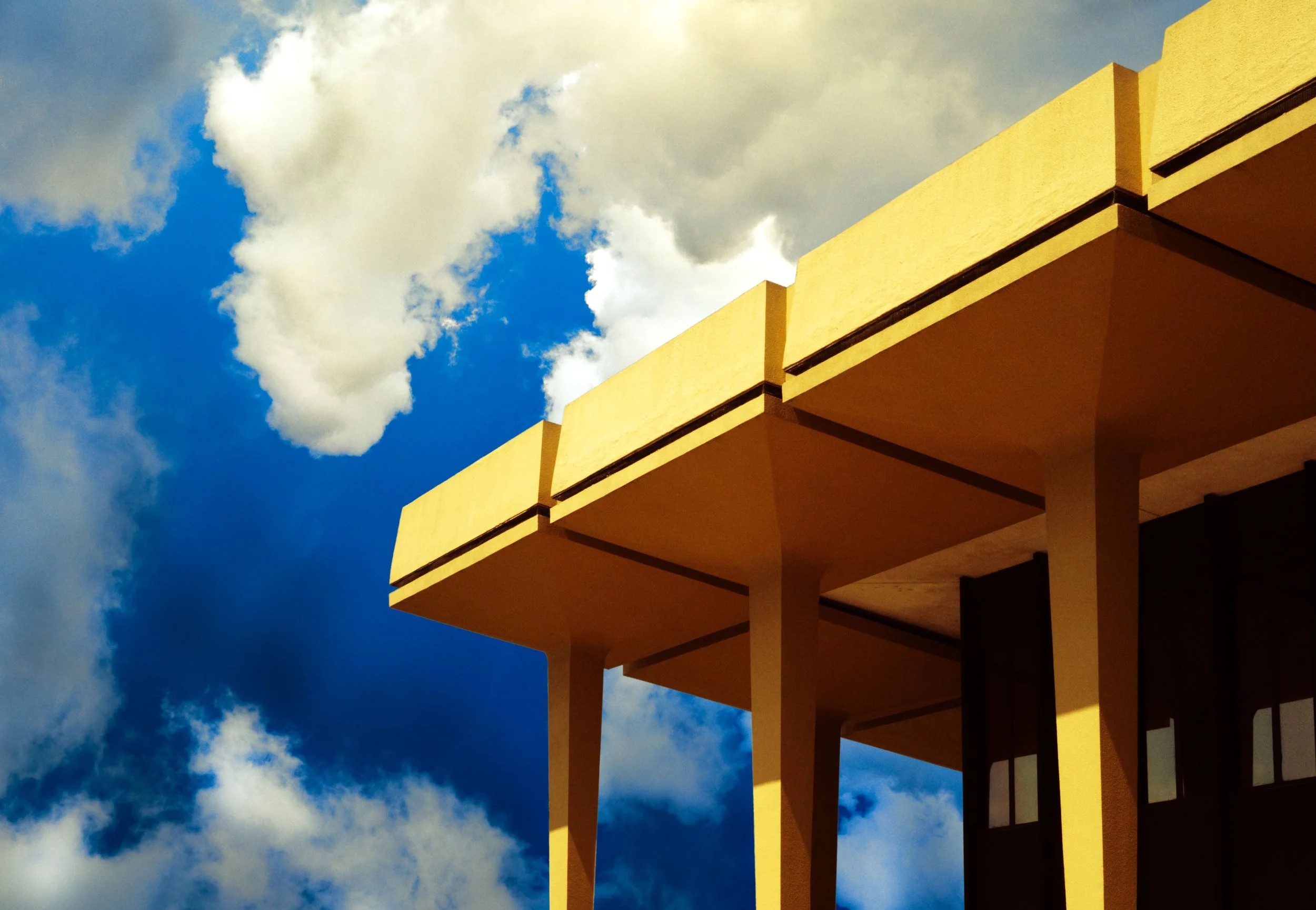
The Temple of Miranda II
When I was very young I watched a short film called All Summer in a Day, based on a Ray Bradbury story. Children living on Venus in brutalist concrete structures, subject to perpetual rain — allowed outside for only one hour, on one day, when the sun came out. The images stayed with me through adulthood. That world was close enough to ours to be recognizable, but altered just enough to feel like somewhere else entirely. I populated my imagination with spaces like that.
As a latchkey kid I lived largely in my own world of fantasy, escaping through movies and books into universes filled with the fantastic. Greek mythology appealed to me for the same reason — its ability to explain the natural world by making everything personal, everything inhabited by intention and meaning. I'll write more about that in another Note.
I've had dreams set in brutalist architectural spaces — buildings that might exist somewhere in a parallel universe running just slightly ahead of or behind our own. Blue skies, full clouds, the same optimistic energy that certain Eastern Bloc governments tried to project through their architecture and propaganda. Imposing, yes. But also somehow utopian.
Which brings me back to the album cover.
When I look at a building now, I sometimes see it differently than it was intended to be seen. The love of mythology gave me a framework: what if Western societies had followed the same line of reasoning as the ancient Greeks, defining our built spaces in terms of the gods and goddesses and the roles they played in shaping human experience? What if that 1970s international style tower was not a ministry of commerce but a ministry devoted to the god of dreams? What if the parking structure was the stables of a goddess?
The Animals cover showed me that this was possible photographically. Hipgnosis took a real, disused power station — a building with no particular poetry in its original purpose — and through the manipulation of light, sky, framing, and one absurd, perfect element, transformed it into something from another world. More fantastic than reality. Strange enough to get lost in.
That's what I try to do. I photograph buildings that I find striking on their own terms — their form, their color, the quality of the light they exist in. Then I manipulate the image to push those qualities further, into the space between documentation and dream. The mythology comes later, as a naming and a framing. But the impulse started here, with a power station, a pig, and a sky that looked like it belonged somewhere else entirely.
Below: Beach Towers VI — one image from my Architecture series, where these influences found their form.
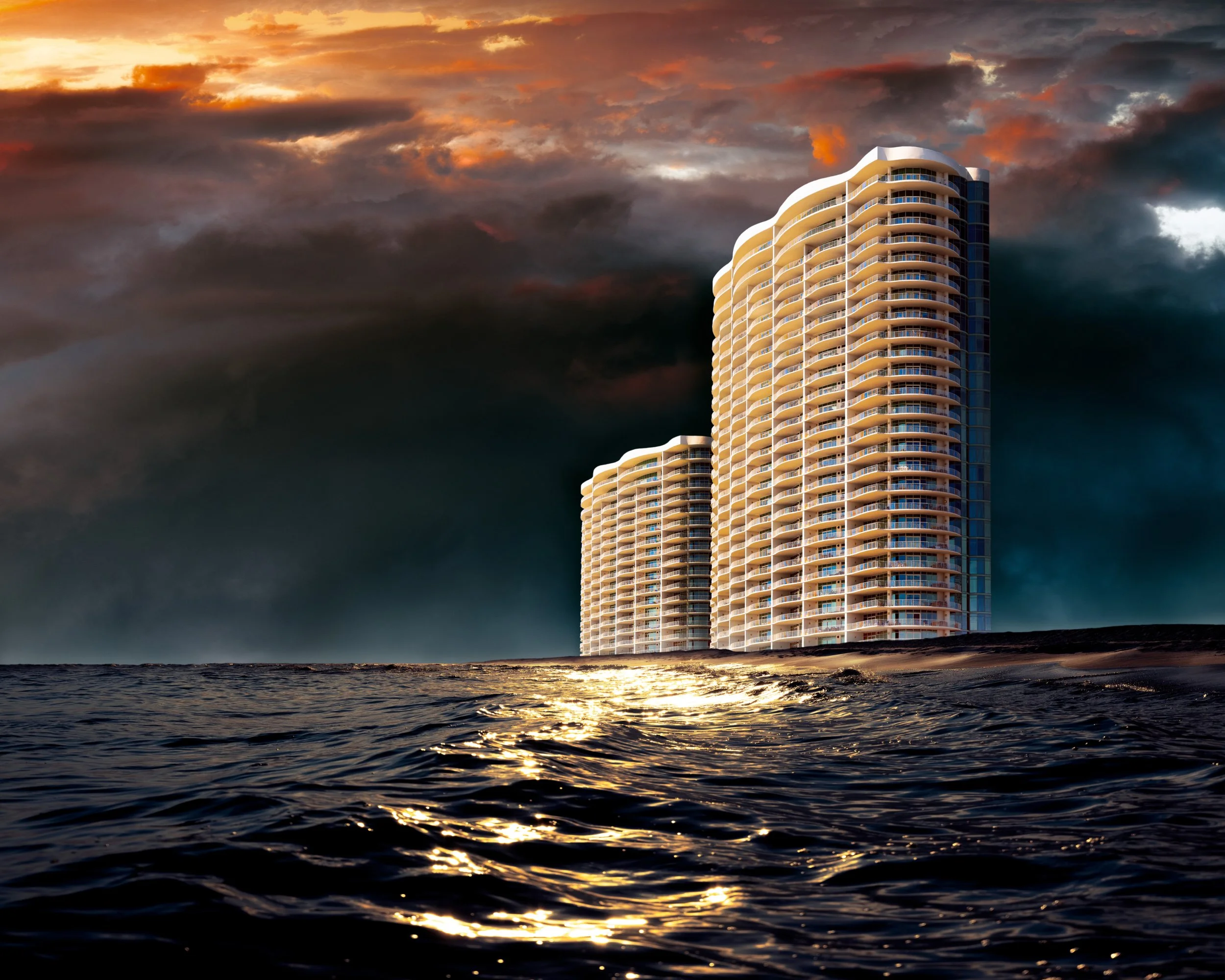
Beach Towers VI
You can explore the full Architecture series, including prints available for purchase, here.