Value-Free: Mythology, Modernism, and the Architecture of Reimagining.
There is a particular kind of building that stops you.
Not because it is beautiful, exactly, though it may be. Not because it announces itself with grandeur, though it might. It stops you because something in its form exceeds its function — because the structure seems to be doing something beyond what it was designed to do, performing a role its architect never specified and its occupants never requested.
I’ve been reading Robert Hughes' The Shock of the New, and a passage stopped me in a similar way. Writing about modernist architecture, Hughes observes: "For if one considers what is actually built, there can be no doubt that modernist culture has its own language of political power. It is not linked to any particular ideology. It is value-free and can mean anything the patron wants."
Value-free. It is a damning phrase, and a precise one.
The architects of the modernist movement did not set out to build value-free structures. Quite the opposite. Philip Johnson, reflecting on the idealism of his generation, captured both its sincerity and its failure with characteristic bluntness: "We were thoroughly of the opinion that if you had good architecture the lives of people would be improved; that architecture would improve people, and people would improve architecture until perfectibility would descend on us like the Holy Ghost, and we would be happy for ever after. This did not prove to be the case."
The gap between those two statements — the soaring idealism and the rueful admission — is where modernist architecture actually lives. The movement produced some of the most extraordinary built forms of the twentieth century. It did not improve people. It did not deliver perfectibility. What it left behind were structures of tremendous formal conviction, stripped of their original meaning, waiting for someone to tell them what they were for.
The Tower of Joy (1920) - Wassily Luckhardt
The history of that waiting is instructive. Wassily Luckhardt's Tower of Joy (1920) remained unbuilt — pure utopian aspiration, never tested by reality. Le Corbusier's Radiant City was built in fragments around the world, and each fragment taught the same lesson: the human element resisted the vision. Paul Rudolph's brutalist structures from the 1950s and 60s stand today as monuments to a certainty that has entirely evaporated, their massiveness no longer ideological but simply physical. And then there is Brasilia — perhaps the most complete experiment in architectural utopianism ever attempted. Niemeyer and Lúcio Costa designed an entire capital city as a monument to modernist idealism, and within decades it had produced the same inequality and dysfunction the vision was supposed to eliminate. The buildings remain extraordinary as objects. As solutions to human problems they were beside the point.
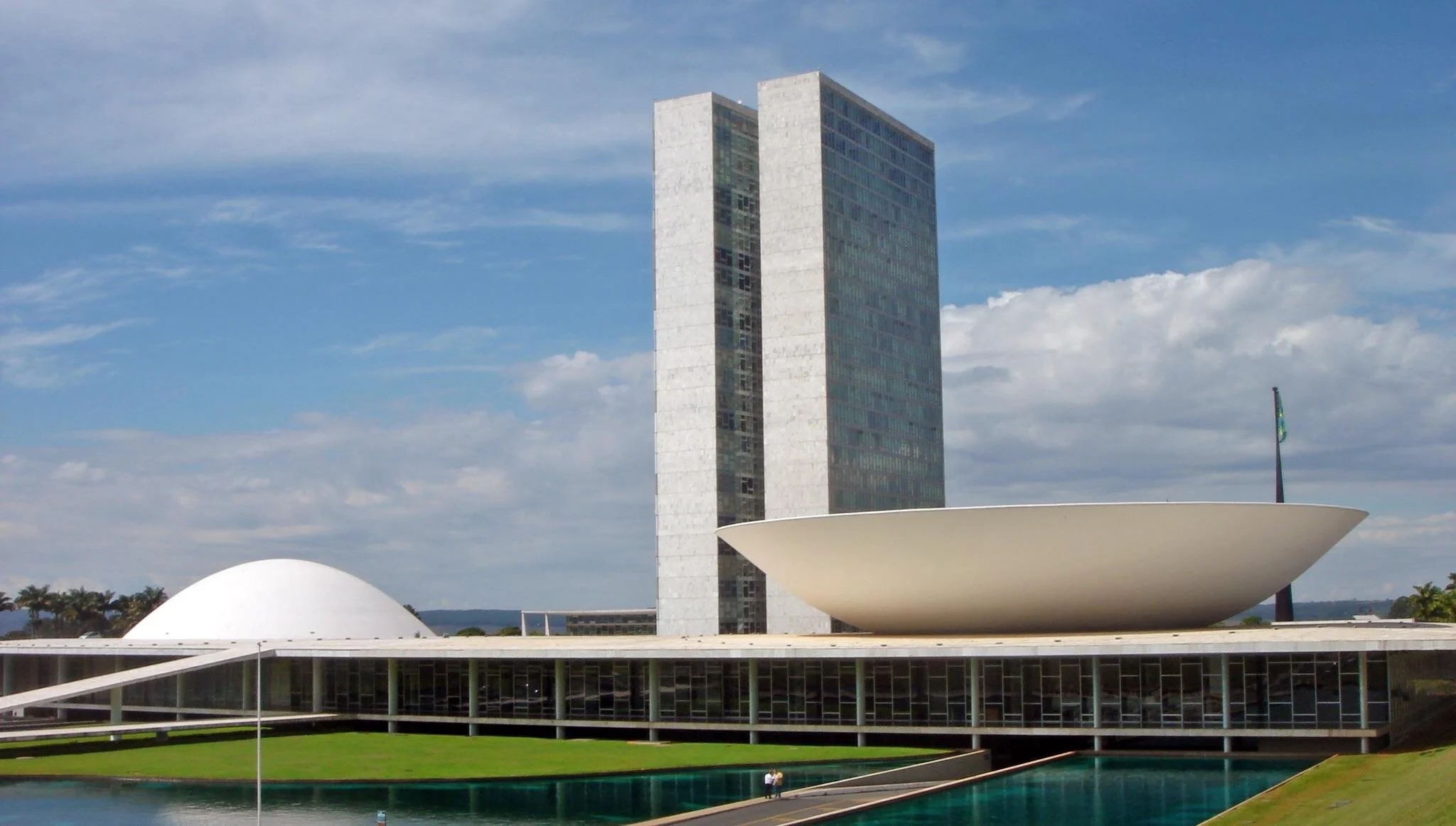
National Congress, Brasilia - 1957-1960 - Oscar Niemeyer
Nelson Rockefeller understood something about this, perhaps more honestly than the idealists. Empire State Plaza in Albany, completed in the 1970s, deployed the full language of modernist architecture — monumental scale, stripped forms, overwhelming civic presence — not in service of utopian improvement but in naked service of state power. Hughes was right. Value-free architecture means whatever the patron wants. In Albany, what the patron wanted was unmistakable.
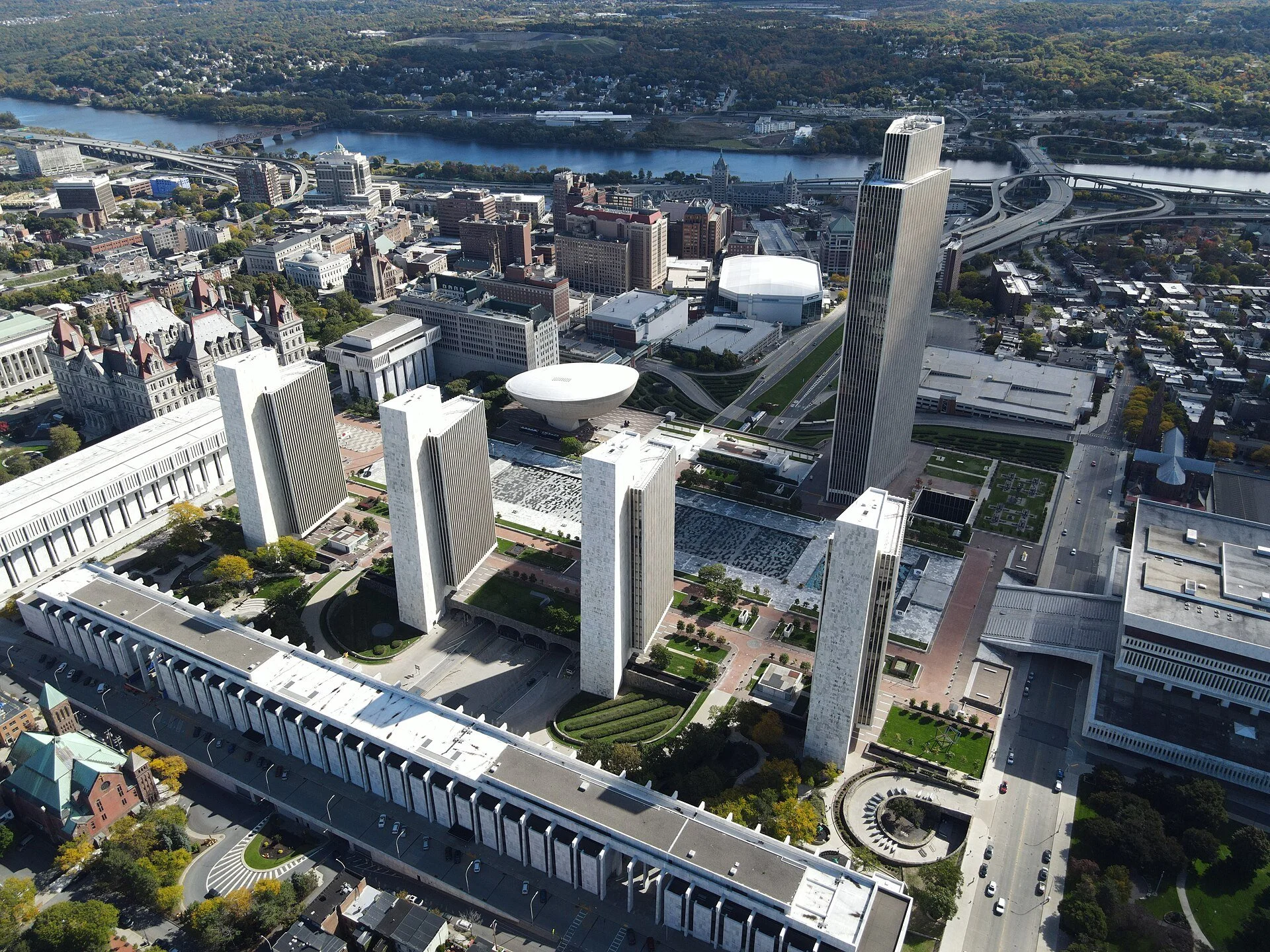
Empire State Plaza - 1965-1978 - Albany, New York
The structures I'm drawn to for my Mythological Architecture series are almost always from this era — the 1950s through the 1970s, the years when modernist idealism was simultaneously at its most ambitious and its most vulnerable. These buildings share a particular quality: they were constructed with total conviction, and that conviction is still visible in their forms even as the ideology has entirely evaporated. What remains is exactly what Hughes describes. Value-free objects. Containers waiting for meaning.
I give them meaning. Not the architect's utopian program, and not the patron's political agenda. Something older and less optimistic — the kind of meaning that doesn't promise improvement but simply acknowledges power, mystery, and the relationship between human scale and inhuman form that architecture has always negotiated, long before modernism tried to resolve it through design.
Mythology doesn't promise perfectibility. It names things as they are. The Cyclopes built inescapable structures. The gods inhabited impossible ones. Power has always required a certain kind of building, and certain buildings have always exceeded the power that commissioned them.
What strikes me, returning to this work, is the abundance of it. The built landscape of the 1950s through the 1970s is vast — civic centers, universities, government complexes, housing blocks, cultural institutions, all constructed with the same conviction, all now carrying the same vacancy where the ideology used to be. The possibilities for reimagining are practically boundless. Greek and Roman mythology offers a parallel abundance — a system so comprehensive, so populated with gods, functionaries, institutions, and places, that it can absorb and define almost anything. The two inventories meet naturally. There is no shortage of buildings waiting for mythological function, and no shortage of mythology waiting to be assigned.
The clearest moment I understood what this series was doing came in Huntsville, Alabama. The building is a county courthouse, completed between1966 and1967 — built at the precise moment Huntsville was being transformed by the Apollo program, when the idealism of space exploration was reshaping everything around it. The structure has a colonnaded exterior, ordered and civic and slightly formal, the columns carrying their ancient associative weight regardless of the modernist vocabulary around them.
I have returned to it more than once. The light there does something particular — it finds the columns and the ordered facade and lifts them out of their civic function into something older and less explainable. Color intensifies what the light begins. What was designed as a courthouse becomes, in certain moments, a temple — not as metaphor but as visual and formal fact. A place of devotion to something the building itself cannot name.
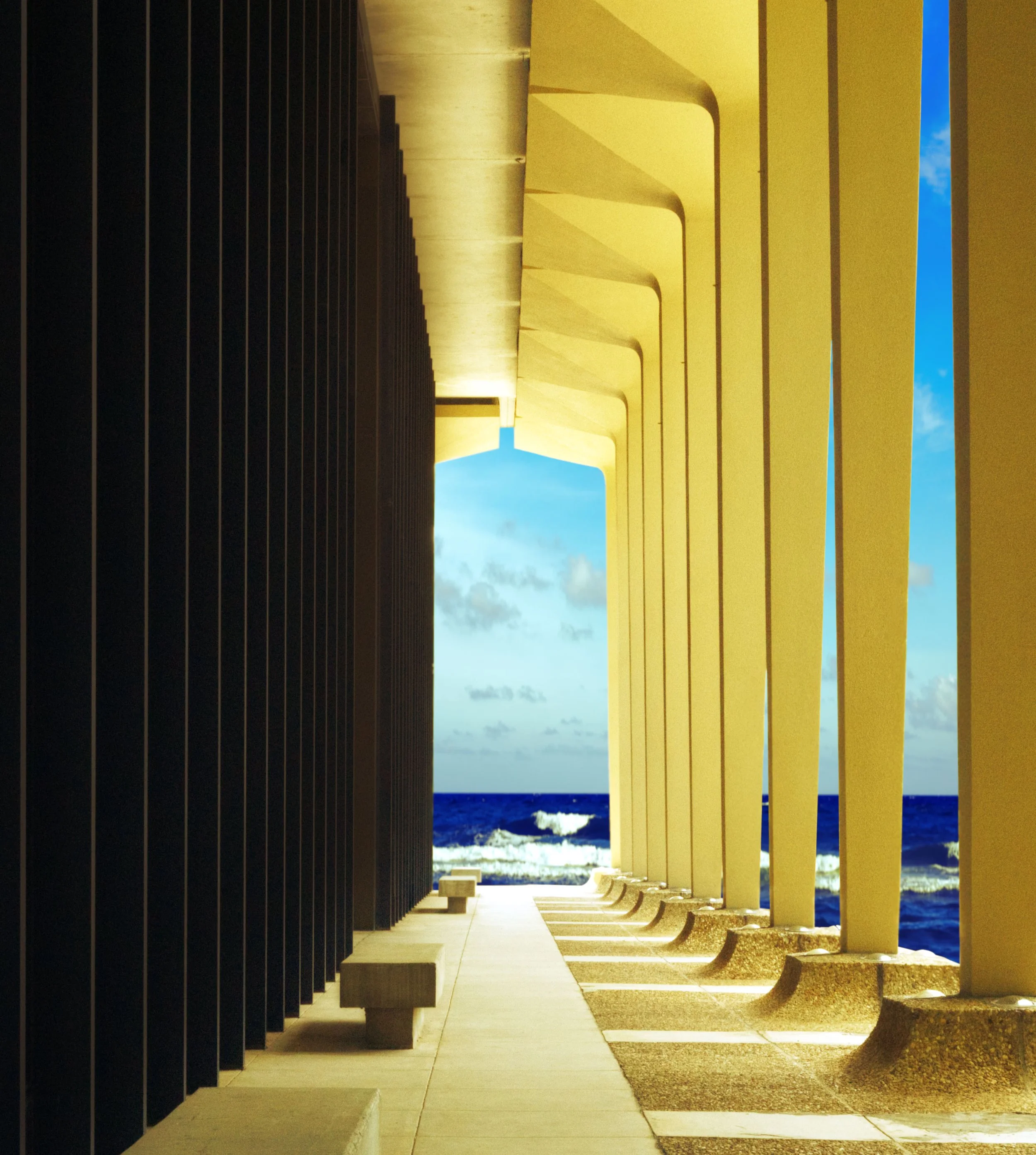
The Temple of Miranda - from the Mythological Architecture series
The Temple of Miranda I and The Temple of Miranda II are the result — the same structure from different vantage points, the mythology arriving differently each time, the building still yielding what it has always quietly contained.
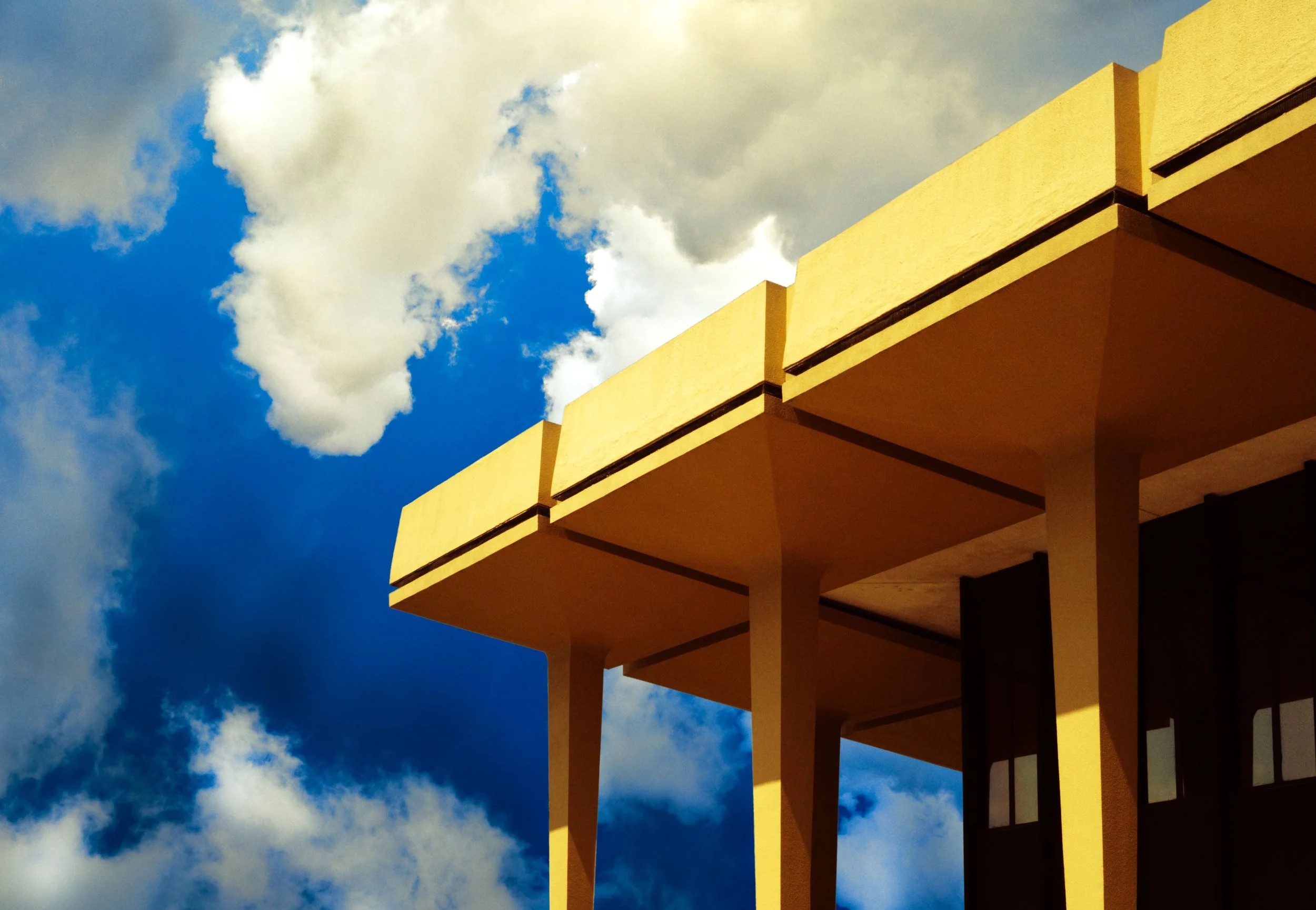
The Temple of Miranda II - from the Mythological Architecture series